Showing posts with label writing. Show all posts

Saturday, 1 August 2020

A shocking success

The contract has been sent by the publisher and I have only to sign it. She and I talked on zoom for over an hour, getting on very well. P was by my side and the children were in the room too, listening.

The questions only arose later. I want to tweak it a little, nothing significant. I have not done a thing. I am paralysed. She has been in touch and I told her I needed more time. I could not tell her how completely floored I am by this success. At least it looks like  it might be the beginning of success. I have another month before the contract lapses. I may need it.

I am so anxious. I have become sick, nauseous, the kind of feeling you get from eating food which is too rich, something to do with the bile. I cannot eat much, and then only stuff without nutritional value. Tinned tomato soup. Crackers with fake butter. Only peppermint tea because I don't like ordinary tea without milk and I cannot tolerate milk right now. Coffee is out of the question. My lovely doctor said it might be a stone, a gallstone. Apparently I have the classic symptoms.

The blood tests have all come back saying I am A OK. The ultrasound is in a week's time and will probably also say that I am fine.  I feel like a fraud. Am I a fraud?

This acceptance of my work has come as a rude shock. My mind is not used to it. I go through ugly spaces. Paranoia, nothing will come of it, the publisher will not perform, the cover will be ugly, or worse, boring, no one will buy it. Or megalomania, the world will beat a path to my door, Peter Jackson will want to make the movie. I spent two days in bed sleeping or reading about the 1918 flu epidemic. It's a good book, informative, but not cheerful.  It is now 4 o'clock in the morning and I am writing  because I cannot sleep any more and at this ungodly hour I can't ring anyone.

I would like to call my sister in Israel but it is Shabbat and she won't pick up the phone on Shabbat. Or rather she will pick up the phone because this being NZ, we are ahead of Israel and it is not yet Shabbat there and when she hears it is me, she will say: "Isn't it Shabbat with you now?" and when I say it is, she'll slam the phone down, fast. I have another sister in Holland who is an angel, always kind and helpful,  but last time we spoke I said things in the wrong way and now I have to wait for her to forgive me. I have to give her time.

I don't know how to get through this. My friend L  who  knows about this situation from the inside said I could ring her, but I'll have to wait for daylight before I can do that.

Some friends wanted to celebrate, meet for lunch, but I could not do it. I am in shock. I need time to get over this. Or maybe just get used to it and get to work, because I have a lot to do before that book is fully fledged and ready to fly.




Friday, 3 January 2014

Displacement

Yesterday I returned to writing my book. At long last. The chapter about the villain, to be precise. It is turning out to be so hard that I can only see myself writing a single chapter from inside his head. I am not even sure that I can do that. I am trying, No - not good enough - I shall do it.
I have printed out Renee's recommendations for my book, no I should shall cross that out, for my book, Renee's recommendations for me, in an assertive font called Elephant, (black and bold) and stuck them by the screen of my computer where they will attract my attention as soon as it wanders.
I must get the book finished this year. There is nothing to stop me, except myself.
Yesterday a friend came for lunch - no, the truth is that I myself invited her for lunch. I did that. I was writing well, I was onto something to break the back of this awful chapter which has held me up for so long. I had returned to it at long last and  I invented a way out of doing the work: one o’clock was near. I went to the kitchen and opened the fridge for some reason ( what reason?) and it seemed filthy, so I cleaned the worst of it, indignant at the distraction. I then also cleaned the toilet, scrubbed the bowl, swept the floor. I worked fast and furious, desperately. It seemed hugely important (I know now it was a displacement activity, but it felt completely urgent and necessary at the time) and instead of being angry with myself, I was furious with poor Diana, who had no idea what this was about and sat at the table and considered me with her peaceful eyes. She knew exactly what I was feeling, we are old friends, good friends, and she had no idea why I was the way I was, which was something like a not very well restrained cyclone. An inner cyclone and trying to pretend that nothing was happening. I was furious for the time I had spent cleaning. A huge anger which radiated out and contaminated everything no matter how pleasantly I spoke, how often I smiled. Everything offended me. I offended everything. I won't say that I offended Diana, because she does not offend easily. We are usually very fond of each other, but yesterday, when I had fled into my room because I couldn't stay a minute longer eating-and-chatting-when-I-should-be-writing, when I left her with P, and when he had left the room too, she quietly slipped out and tried to run away home. I caught her at the front door and forced her to come back - she is very polite - and the three of us followed the original plan, which was a good one, going for a substantial walk at 3:00 pm to the top of the hill which is near our house, through the bush and up to the top where the wind was blowing, hard. By the time we got back home it was late afternoon and we had been out for two hours. Diana left immediately, poor thing.

That evening, I went out again, with another friend I am fond of, for another walk, a short one. I was not angry at all by then (why not?). I had not seen her for a long time - which was unusual. Short walks with her used to be part of my routine, part of the way I kept sane, balanced (I hope).
I did no more writing yesterday. P and I were tired.

This urge to write is to be respected and worked on. Renee says that I don't write enough.I'll go for a thousand words a day, 6000 a week. No writing on Saturdays.

I'll finish this chapter before I leave for the Zen retreat, which is in ten days time. Is that reasonable?
I shall shut myself in my room, which is a good place, and write. If I allow any more time, the work will smear itself over too long a period, which is what has happened this last year.
I return on the 20th and then I need to work without abating, without seeing anyone, like a monk on a retreat.
Is that too extreme? I'm afraid I won't last. How to manage the keeping in touch ? Maybe not do it,  though I end up weirded out if I haven't spoken to anyone for a while.We might meet friends in a cheap restaurant rather than feed them here. Go to a movie once in two weeks. Keep up the short walks. I shall finish the writing about my grandfather by the end of February, even though we are going away.

What I have now is not good enough. It is a collection of short stories, rather than a single story I can tell all in one go in a flow.Telling that story is what is to be done, by me.

Writing this is a displacement activity. Bah!
Get on with it, girl!

Monday, 26 August 2013

Remembering and moving forward

Finished Vargas Llosa's The Feast of the Goat in a day more or less, fascinated by the detail - this corresponds to Renee's telling me to 'write more, more' more' and me understanding a little better what she means, so took something I'd written in the past and inflated it with words, ideas, more detail, and to my surprise found the process satisfying.

He writes the novel going forward in two different periods in parallel, someone in the present who is visiting San Domingo after a long absence, and who remembers the past for us, and in the past moving forward towards the murder of Trujillo and  its consequences.

I am particularly inspired by the description of Trujillo, the way his thinking is portrayed and the mystery which links the pieces. The book is strong on atmosphere, the heat, despair and fear almost palpable.


Friday, 7 June 2013

Too much grief

Someone told me that one of my Nuremberg stories contains too much grief, it is sadness piled upon sadness. I can see what they mean: who wants to read stuff that is about grief and that's it?

The novel is like that too: the beginning is the most powerful, about the injustice and pain, the betrayals and losses. My mentor suggests that I turn it round - the past as flashbacks, seen from a place of safety. The reader is told that the people will escape. Whenever I think about it, it seems unbelievable that they did. I wonder what was special about them. Maybe it was just luck. Four members of one family each navigating across murderous currents by whatever means of salvation available. I can't do anything much today. I shall write and write and see what arises.

I have read Aharon Appelfeld's The Story of a Life (Schocken Books, NY, 2004) translated from the Hebrew by Aloma Halter. She does an excellent job of it. The novel told me something I didn't know, or only knew confusedly: the effect of the period immediately preceding the Six Day War on those who had been victims of the Second World War.

After the war broke out, my parents drove all the way from the North to the South of Israel to visit me, because 'Your mother needed to see you', said my father. I was a young soldier guarding a settlement near Gaza, my focus was on adapting to the new Israeli culture, learning Hebrew, learning about the army, everything at once, my head and my heart in a whirl. I missed childhood friends left behind in Europe. I was still a child myself. But around me, everyone was amazed that they had made the trip.

Appelfeld belonged to a club of survivors from Galicia and Eastern Europe.
 "I was called up for reserve duty., and club members vied with one another excitedly to show their support. People pushed banknotes into my pockets, and one of the less popular members (in part because of his miserliness) actually took off his gold watch, gave it to me, and said, "In my name and in the name of my family". Later I learned that this watch had belonged to his brother, who perished in Auschwitz."
 "Be Shmi U Be Shmi Mishpachti." A blessing - implying May your arm be strong and mighty against those who wish to destroy us. It must have seemed unbelievable that we might survive. I don't recall giving it a thought.

I have just realised that I was reading this book yesterday, on June 6th.It portrays the effect of war-time experiences on children with power and accuracy. No amplification. I found it very moving.

Friday, 17 May 2013

Structure, structure, structure...


I've been reading The Immortal Life of Henrietta Lacks by Rebecca Skloot (Picador, 2010).  I knew about tissue culture and HeLa cells from my studies, so I skimmed through the beginning . The story took off for me once we reached the time when Deborah and Rebecca are researching the past together, the description of the difficulties arising from their own limitations and anxieties, and the way they resolved them. It carries the tone of truth-telling which makes the story speak to you from the page. Rivetting.

What impressed me most about this book is how painstaking Rebecca Skloot has been - careful to do justice to everyone who has contributed, the utmost care! This book has the longest list of acknowledgements that I have ever seen: it is a chapter in its own right, and it is well written too, I read it with great interest and a steadily increasing respect for the author. There is a proper index, a must for a book in this genre, but still, not everyone takes the trouble.There are the Notes, which provide the sources for each chapter. And the years in which the story takes place are written in a little stream at the head of each chapter with an arrow pointing to the relevant period .Very meticulous (unnecessary, to my mind, I read the book without any difficulty re the chronology and only noticed this feature later on.) There is also an Afterword which fills us in on the latest developments.

And yet it has not prevented the attacks: I read one vicious review which said that there was far too much of her in the book...Because she did the work without which no one would know what happened, the course of that work is the story, the story of how she managed to convince Deborah and the family to trust her, at some emotional cost to herself. Not an easy path, requiring great perseverance. She has done a good job of it, with considerable integrity.

This book brought me an unexpected gift: it has put me in touch with theory about structure. I have been worried about the structure of my book for some time and when I looked at Rebecca's website rebeccaskloot.com, I found that she said this about structure in an interview for the nieman storyboard:


" I knew that the structure was going to have to be complicated, and I’m just very into structure. I think structure is one of the most important tools a writer has. When I teach, my students get so sick of me harping on structure, structure, structure. I read and dissect a lot of things. I teach John McPhee’s stuff because he uses these very complicated structures you can pull apart. Structure is all about making the story more rich."


http://www.niemanstoryboard.org/wp-content/uploads/2010/07/skloot-system1.jpg


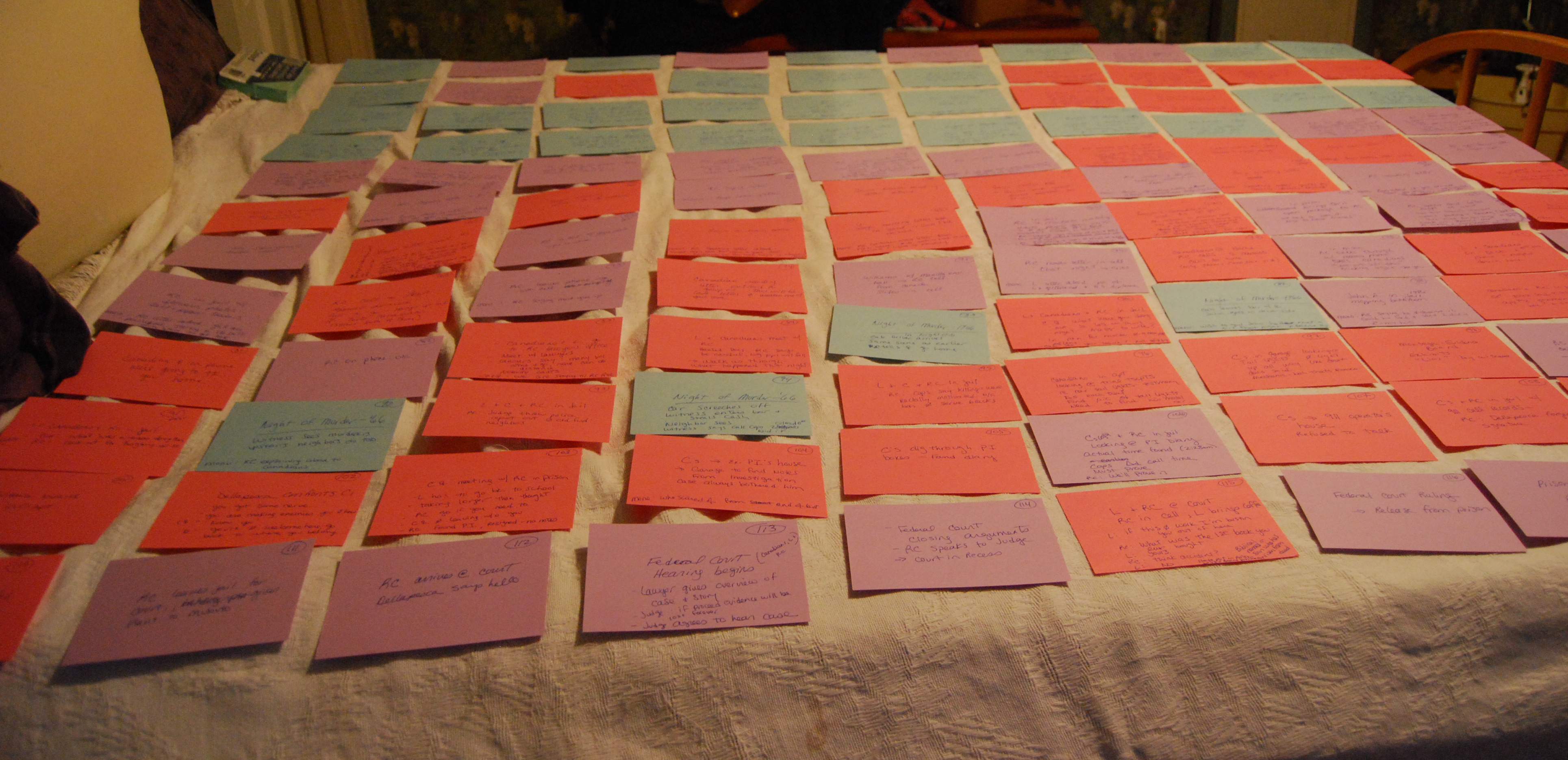
Here's a photo of the way she sorted out the structure: three interwoven stories, three colours.  I was touched by this photo because I recognised it:  I have done the same thing on our large dining table for my book, using colours for the four different interwoven stories and I did that because the structure was wrong and I was stuck. I recently found a way getting around some of the difficulties, involving, you guessed it, flashbacks. The issue now is - how to place them judiciously.

So on to "John McPhee's stuff".  Here is a quote from the first article I found about him:
“...The narrative wants to move from point to point through time, while topics that have arisen now and again across someone’s life cry out to be collected..."
The method is indicated for non-fiction writing, and mine is a mix of fiction and non-fiction - knowing more can only help! Some people advising me are writers of fiction, and they do not feel the same way about sticking to the facts when dealing with historical events. I have been told: "Readers will forgive you!"  I don't want to have to be forgiven....

I also would like to mention that I have been encouraged to read how long it took Rebecca to write this book. Not that anything is likely to stop me at this stage.

Thursday, 1 November 2012

About not doing and driving

I can't get myself into what I want to do.
When I was translating, I was consumed by it, ran from my bed to the computer every morning, forgot to eat.
I have several things on the go right now, besides the neglected garden, which will remain neglected because it is last on the list.
I have to finish the form to renew my driver licence - realised after 30 years in this country that the local name is driver licence, not drivers' licence. A licence to drive, it is mine, but the name means that the fact that it is mine is not the point. Maybe it should be called a driving licence.

I want to :

translate from German an anti-Semitic sentence which was carefully painted in Gothic script on the wall of a house in Bavaria in 1934, richly illustrated, full colour.

WRITE.


painstakingly insert corrections into a translation and publish it.

translate more stuff.

Instead, I have spent the last hour or so reading Bodil Malmsten's website, translating from Swedish with Google translate, a muddled affair. I almost wrote 'with the help of Google Translate', but sometimes I feel it is 'in spite of'. I mustn't, because without GT, I couldn't read her at all. Only a little of her work is translated to English, just the wonderful The Price of Water in Finistere. Very sad.

Tuesday, 17 May 2011

Messiness

Wrote a short story based on Einat's visit and Memorial Day (for Israel Defence Force soldiers), which needs more work. Several people have read it, all had suggestions to make, not one the same as the other, which means that it is not quite right in some way, since all the suggestions are quite far-reaching.

I am pleased with it anyway, writing it has satisfied a need in me. I shall save this version and play with version B to see where that may lead me.

I have managed in a mysterious and disastrous way to lose some of the writing which is the new beginning for the book. Only a few pages, but they packed a punch. A by-product of having spent a lot of time on it, is that when I re-write now, it may flow out pretty much as it was.

I also cannot find a letter I thought I'd written about the translation to be published.Maybe I only thought I wrote it?

Best was cleaning the kitchen this morning. You start with dirt and get rid of it and feel good. Nice and simple.
Unfortunately time-consuming and a diversion from what really matters.

Monday, 10 March 2008

The Book of Longing

I always start the process of blogging by re-reading what I wrote yesterday. I want to edit out some of the mistakes I make, if I finish today early enough shall do that. Mistakes in grammar mainly, not many.

Naipaul made Theroux swear that he would not write poetry. Theroux was unpublished at 24 when they met. Naipaul recognised his talent, Th was writing and had shown what he wrote to no one.

Here's what Naipaul said about keeping a diary (or a journal like this?):

...he analyzed my keeping a journal and rejected the idea. I must abandon it, he said. It was just a way of anthologizing experience. A writer was not a writer because things happened around him. A writer did other things. A diary, more detailed, was worse - I should not even think about it. (p.114)

Part two of the book which I am now well into and where the above excerpt is from is called The Writer's Writer. Maybe I'll understand that at the end.

Regarding poetry:

I went to The Book of Longing performance last night at the MFC, we had cheap cheap seats overlooking the stage and it was fabulous, we could see everything that was happening and why and how, the conductor's image relayed via VDUs, the people coming and going, even read the writing around the drawings by LC and of LC that were projected on the backdrop - the poetry came out well, the Philip Glass music was faithful to LC, I felt it was related to Suzanne and I liked as well the solo performances by the musicians, (the drummer didn't get one), the music was lancinant that is a word I first met as a description of Beaudelaire's poetry, and of course longing is lancinant in its essence, the dictionary I've got - not the best - says that it translates as shooting (for pain), haunting (for obsessive) and insistent (in the case of a monotone). I think haunting is the best here, though lancinant is less ghostly. Translation of literature is a huge responsibility, almost like writing a new book.


Towards the end came the poem about LC's Roshi dying and right at the end LC's thank you poem said thank you to us, To my teachers and to everyone, it did not feel like a pose. Best of all they issued everyone with a little pamphlet of the libretto of the show, except that there were no names of performers, only Leonard C as author and Philip Glass, who was there in person playing one of the electronic whatsits, looking Jewish and a little dusty.

The 20 min are up.