Showing posts with label Holocaust. Show all posts

Tuesday, 10 February 2026

The Ringelblum Archive and the Warsaw ghetto

During the Second World War, all Warsaw's Jews were imprisoned in the ghetto. Some poems written during this time were preserved, despite the Nazis' strenuous attempts to eradicate all Jews and Jewish culture. The poems were buried in milk cans together with other writings, not all of them poems. These writings by multiple authors form what is now known as the Ringelblum Archive, Ringelblum being the name of the far-sighted man who insisted on documenting for posterity what was happening to Warsaw's Jews and their cultural artefacts, and who also found a way of securing the archive for future generations. Of which I am a member. 

After the Nazis had emptied the ghetto of its Jews, they erased it. No buildings remained. When the war ended, one or two survivors returning from the camps rescued this milk can and one other from the places where they'd been buried. A third one was lost, presumably discarded, because the Chinese embassy was built where it was hidden. I believe the contents of the two milk cans are now kept in the Holocaust Museum in Washington.

The poems from the Ringelblum Archive have been translated from Yiddish and can be found online here on the website thesongremains.org. The wife of Binem Heller, a powerful poet, can be seen here on Youtube declaiming one of his heart-rending poems in Yiddish, Mein Schwester Chaye (My sister Chaye, with English subtitles). He compiled a collection of Yiddish poems by Jewish Polish poets which was published in 1951. It includes the poem below by Yisroel Shtern, who died in the Warsaw Ghetto in 1942.       

 A phrase about man in an old holy book 

by Yisroel Shtern

Though Springtime, there was rain and snow,
and above the columns of night
grief clambered like a cat and terrorized all the roads.
I sat alone, leafing through an old holy book.

Then a phrase transcending generations shimmered
through my home like a crown, a proud phrase though old,
but I did not move towards this dream
with a silver platter, with bread and with salt.

And the phrase did not flash like lightning during my sleep,
and in the morning it did not sit by my head
with daggers of judgment and punishment aimed at my eyes;
it didn’t gnaw like sulfur permeating my days.

I arose Spring-like with the day’s dance,
wrote joy with my stick in the warm sand.
Woe did not drip into my breakfast repast
when a bloodied Jew came sliding along the wall

Leaden and blind like a cloud, unable to locate his house;
when laughter curls itself into the hairs of the brutes;
when my street hightails it swiftly and small as a mouse.
And in the park trees stand like hunters’ guns…

Neither the morning nor the afternoon was ashamed.
And the sun towered golden in town.
And neither in the sun, nor in the tree, nor in me did burn
the old-holy-book-phrase: “Man is formed from God”…


In memory of Dr. Sarah Moskovitz and her work with child survivors of the Holocaust.


Friday, 7 June 2013

Too much grief

Someone told me that one of my Nuremberg stories contains too much grief, it is sadness piled upon sadness. I can see what they mean: who wants to read stuff that is about grief and that's it?

The novel is like that too: the beginning is the most powerful, about the injustice and pain, the betrayals and losses. My mentor suggests that I turn it round - the past as flashbacks, seen from a place of safety. The reader is told that the people will escape. Whenever I think about it, it seems unbelievable that they did. I wonder what was special about them. Maybe it was just luck. Four members of one family each navigating across murderous currents by whatever means of salvation available. I can't do anything much today. I shall write and write and see what arises.

I have read Aharon Appelfeld's The Story of a Life (Schocken Books, NY, 2004) translated from the Hebrew by Aloma Halter. She does an excellent job of it. The novel told me something I didn't know, or only knew confusedly: the effect of the period immediately preceding the Six Day War on those who had been victims of the Second World War.

After the war broke out, my parents drove all the way from the North to the South of Israel to visit me, because 'Your mother needed to see you', said my father. I was a young soldier guarding a settlement near Gaza, my focus was on adapting to the new Israeli culture, learning Hebrew, learning about the army, everything at once, my head and my heart in a whirl. I missed childhood friends left behind in Europe. I was still a child myself. But around me, everyone was amazed that they had made the trip.

Appelfeld belonged to a club of survivors from Galicia and Eastern Europe.
 "I was called up for reserve duty., and club members vied with one another excitedly to show their support. People pushed banknotes into my pockets, and one of the less popular members (in part because of his miserliness) actually took off his gold watch, gave it to me, and said, "In my name and in the name of my family". Later I learned that this watch had belonged to his brother, who perished in Auschwitz."
 "Be Shmi U Be Shmi Mishpachti." A blessing - implying May your arm be strong and mighty against those who wish to destroy us. It must have seemed unbelievable that we might survive. I don't recall giving it a thought.

I have just realised that I was reading this book yesterday, on June 6th.It portrays the effect of war-time experiences on children with power and accuracy. No amplification. I found it very moving.

Sunday, 31 July 2011

Champagne at the bus stop

Only my second post this month. I returned from a Zen retreat after just three days when a person close to me became ill. He was - still is - in a lot of pain, on morphine at times. We spend most of the time in silence. He seems to like it as much as I do.

Hojin
Judy Hojin Kimmel
The retreat was led by Hojin Kimmel of the Zen Mountains and Rivers Order. She ran an art workshop on the first day  - something they call journalling; I learnt some useful ways of expressing oneself a la Natalie Goldberg, painting and writing in concert, practical methods of managing.

During the morning before I left, it happened that I looked up towards the altar where she was sitting and had a perception of emptiness, as if no one was there. 

Earlier this month, I enjoyed reading a graphic novel entitled Persepolis, by  Marjane Satrapi (Pantheon, 2007), an autobiography revealing the effect of fundamentalist Islam on a young girl in Iran. Someone had lent me the book, and as soon as I finished it, I bought my own copy, the complete work in two volumes: the first  is better, I think. The illustrations are plain line drawings, black and white, most expressive. The story has been pared down and down, very good.

A recent experience: I was one of the winners in a translation competition with a translation of Rosa Ausalender's Dichten. Rosa Auslaender managed to survive the Holocaust and returned to Germany after the war. She is regarded as an important 20th century poet, a friend of Celan's. Her most famous poem is entitled Motherland:

Mutterland


Mein Vaterland ist tot
sie haben es begraben
im Feuer


Ich lebe
in meinem Mutterland
Wort
 
The local Goethe Institut and the German lecturers at Victoria University organised an exhibition of her poems in German, with wonderful photos, accompanied by translations of varying quality - some were by established translators, some by students, some by Google Translate. A translation workshop was great fun: Lloyd Jones read a translation he'd worked on, and so did Kate Camp, beautiful.

I don't feel that my work is as good as theirs by any means  - but maybe it has the quality of being faithful to Rose Auslaender's words. I am not sure how pleased she would be herself. She may have liked some of the minimalist translations, which allow a lot of air around the words, letting them float.

The four winning entries will be posted in bus-stops around Wellington for two weeks. My friends say, let's party in the bus stop, drink champagne! It will be fun!

photo
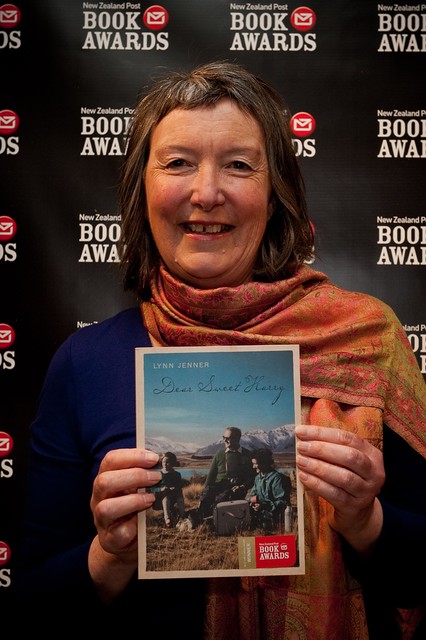
Poet Lynn Jenner
On a different scale altogether: Lynn Jenner's book Dear Sweet Harry won  the Best First Book of Poetry Award in the 2011 New Zealand Post Book Awards - congratulations, Lynn!

Monday, 2 May 2011

On reading the Todesfuge at the Holocaust Memorial Ceremony

At the Holocaust Memorial ceremony last night, the programme cover said in big words Compassion and Re.....(can't remember the Re... word right now - forgetting words happens more frequently: during the week-end, forgot the word 'parsnip' for a while. I stood and stared at the parsnip and only the p came back. The rest of the word absented itself for a couple of hours).

The Holocaust is not about Compassion and Re..... (I'll add the Re word when it comes back, at the end of this post), which were one might say, significantly lacking at the time. Restrained myself from prefacing my reading by mentioning that even if the 12 000 Righteous Gentiles had been double the number, that is 24 000, and even if each of them had saved 10 Jews - which most did not, though a few saved thousands - only 240 000 Jews would have been saved. Reminded myself that 'He who saves the life of one person, it is as if he had saved the entire world." (Who said that?)

Someone whose opinion I value said I read Celan's poem 'appropriately', the best compliment that evening - some people came to tell me I'd read well. The poem seemed to take over, and there was the intent silence of attentive people. Several people had previously turned down the opportunity to read that poem, too difficult to read, they said, no punctuation.

I am glad that it ended up being me. A duty fulfilled. It was a bit of a battle to get it into the programme - another poem by a Holocaust Survivor was suggested, about a credo about belief  in human goodness. I responded that it was 'powerfully optimistic' whereas Celan is not a comfortable read (Hah!). But then the Holocaust was not a comfortable event.

Still waiting for Re... to reappear.

The poem about a survivor's belief in human goodness (Alexander Kimel) was read last, after several poems and songs which were full of grief. That felt like the right place for it, a positive thought to go home with.

Added the next day: the Re... word was Resilience.

Sunday, 18 April 2010

About Goodness

I've been reading about the Holocaust and came across a book which made an impression on me - less despair, more uplift.

One of the lessons which can be drawn from the Holocaust may be that if such horrendous evil is possible, amazing good must occasionally happen as well. The book is called Rescuers of Jews during the Holocaust, by Carol Rittner and Sandra Myers, eds. (NYU Press, 1986).

Of particular note: an entire village in France saved thousands. It is called Le Chambon, may it always be remembered for a blessing.

Also a Bavarian army officer called Major Julius Schmahling who saved many people in the Haute Loire. He is linked to the village and helped them.