Showing posts with label Translation. Show all posts

Friday, 7 June 2013

Too much grief

Someone told me that one of my Nuremberg stories contains too much grief, it is sadness piled upon sadness. I can see what they mean: who wants to read stuff that is about grief and that's it?

The novel is like that too: the beginning is the most powerful, about the injustice and pain, the betrayals and losses. My mentor suggests that I turn it round - the past as flashbacks, seen from a place of safety. The reader is told that the people will escape. Whenever I think about it, it seems unbelievable that they did. I wonder what was special about them. Maybe it was just luck. Four members of one family each navigating across murderous currents by whatever means of salvation available. I can't do anything much today. I shall write and write and see what arises.

I have read Aharon Appelfeld's The Story of a Life (Schocken Books, NY, 2004) translated from the Hebrew by Aloma Halter. She does an excellent job of it. The novel told me something I didn't know, or only knew confusedly: the effect of the period immediately preceding the Six Day War on those who had been victims of the Second World War.

After the war broke out, my parents drove all the way from the North to the South of Israel to visit me, because 'Your mother needed to see you', said my father. I was a young soldier guarding a settlement near Gaza, my focus was on adapting to the new Israeli culture, learning Hebrew, learning about the army, everything at once, my head and my heart in a whirl. I missed childhood friends left behind in Europe. I was still a child myself. But around me, everyone was amazed that they had made the trip.

Appelfeld belonged to a club of survivors from Galicia and Eastern Europe.
 "I was called up for reserve duty., and club members vied with one another excitedly to show their support. People pushed banknotes into my pockets, and one of the less popular members (in part because of his miserliness) actually took off his gold watch, gave it to me, and said, "In my name and in the name of my family". Later I learned that this watch had belonged to his brother, who perished in Auschwitz."
 "Be Shmi U Be Shmi Mishpachti." A blessing - implying May your arm be strong and mighty against those who wish to destroy us. It must have seemed unbelievable that we might survive. I don't recall giving it a thought.

I have just realised that I was reading this book yesterday, on June 6th.It portrays the effect of war-time experiences on children with power and accuracy. No amplification. I found it very moving.

Wednesday, 2 January 2013

Names in novels - a view according to Echenoz


I enjoy the names Echenoz gives his charactes in Big Blondes (1997, translation with occasional clumsiness by Mark Polizzotti, The New Press) (Les Grandes Blondes, 1995, Editions de Minuit) and while checking whether one in particular was a total fiction or existed in reality (Personnettaz - so weird, and yes, it is a real name), came across a review in Liberation entirely dedicated to this topic, which you'll find here (in French). Echenoz compiles lists of names he likes as he comes across them, before he may need them. They may not always be the names of actual people: he finds them anywhere - in the train or on the entrance to a factory.

He says: "Reading Henry James' Notebooks, I was struck by the list of names he kept in reserve."
He likes names that work in several languages and over several periods, that have belonged to a variety of people - Arbogast (the heroine's family name in Big Blondes) was the name of a bishop in the 5th century, a general under Theodosius [Roman emperor, 347-395], a French mathematician in the 18th century and the name of the detective in Psycho. First names matter too - they add something, though he says that he is incapable of explaining why the sexy active girl in Big Blondes is called Donatienne, an uncommon name - the name came to him and that is who she was - no question.

Each name is different from all the others and conjures up a specific personality: the reader has no difficulty in remembering who they are.

In Echenoz's following book, Piano (also translated by Polizzotti) one finds that he has been unable to let go of two of the names so carefully chosen and that they reappear, one of them with a wink to his previous incarnation. That book was reviewed in the Independent.

I shall write more when I've finished reading Big Blondes - about the use and practice of irony, which ties in with Vila-Matas' book about Never any end to Paris...

Sunday, 31 July 2011

Champagne at the bus stop

Only my second post this month. I returned from a Zen retreat after just three days when a person close to me became ill. He was - still is - in a lot of pain, on morphine at times. We spend most of the time in silence. He seems to like it as much as I do.

Hojin
Judy Hojin Kimmel
The retreat was led by Hojin Kimmel of the Zen Mountains and Rivers Order. She ran an art workshop on the first day  - something they call journalling; I learnt some useful ways of expressing oneself a la Natalie Goldberg, painting and writing in concert, practical methods of managing.

During the morning before I left, it happened that I looked up towards the altar where she was sitting and had a perception of emptiness, as if no one was there. 

Earlier this month, I enjoyed reading a graphic novel entitled Persepolis, by  Marjane Satrapi (Pantheon, 2007), an autobiography revealing the effect of fundamentalist Islam on a young girl in Iran. Someone had lent me the book, and as soon as I finished it, I bought my own copy, the complete work in two volumes: the first  is better, I think. The illustrations are plain line drawings, black and white, most expressive. The story has been pared down and down, very good.

A recent experience: I was one of the winners in a translation competition with a translation of Rosa Ausalender's Dichten. Rosa Auslaender managed to survive the Holocaust and returned to Germany after the war. She is regarded as an important 20th century poet, a friend of Celan's. Her most famous poem is entitled Motherland:

Mutterland


Mein Vaterland ist tot
sie haben es begraben
im Feuer


Ich lebe
in meinem Mutterland
Wort
 
The local Goethe Institut and the German lecturers at Victoria University organised an exhibition of her poems in German, with wonderful photos, accompanied by translations of varying quality - some were by established translators, some by students, some by Google Translate. A translation workshop was great fun: Lloyd Jones read a translation he'd worked on, and so did Kate Camp, beautiful.

I don't feel that my work is as good as theirs by any means  - but maybe it has the quality of being faithful to Rose Auslaender's words. I am not sure how pleased she would be herself. She may have liked some of the minimalist translations, which allow a lot of air around the words, letting them float.

The four winning entries will be posted in bus-stops around Wellington for two weeks. My friends say, let's party in the bus stop, drink champagne! It will be fun!

photo
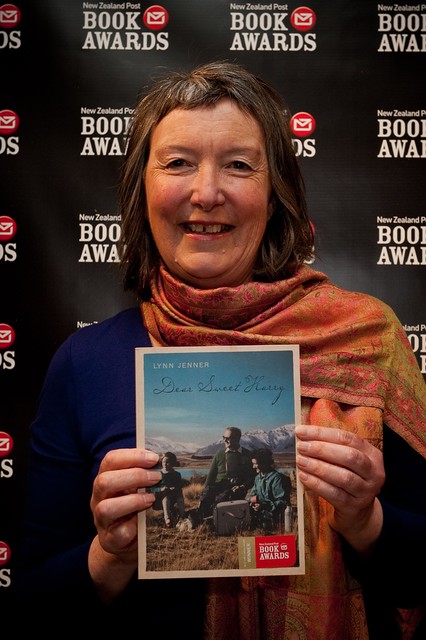
Poet Lynn Jenner
On a different scale altogether: Lynn Jenner's book Dear Sweet Harry won  the Best First Book of Poetry Award in the 2011 New Zealand Post Book Awards - congratulations, Lynn!

Friday, 17 June 2011

Slowness

A blobby day, too much physical exercise has tired me out. Rest does not seem to help - even lying down feels like an effort.

And so re-read Milan Kundera's Slowness (Faber and Faber, 1996) in a good translation (from the French) by Linda Asher. The original La Lenteur was published in '96. I'd bought it because of its title as well as because of Kundera, because I'd just finished a brilliant book translated from German, The Discovery of Slowness (2004) by S. Nadolny, translated from German by R. Freedman from Die Entdeckung der Langsamheit (1999), which is the biography of John Franklin, an exceptional man, who suffered from a slowness in his ability to process incoming stimuli, and developed a profound understanding of many things nevertheless. He became Governor of Tasmania (19th century).

I once asked a clever psychologist whether speed (of response to the questions of a test) and intelligence were always linked, and he was surprised and said of course; indeed, the Wechsler Intelligence test - commonly known as the IQ test - rates people partly on the speed of their responses. This book shows how that might lead to an erroneous assessment.

To return to Kundera's book. It is three-quarters good: the ending is disappointing, almost trite. Most of it is witty and very well written, often describing a superficial intellectual discussion between men, with a commentary on what is happening underneath, who wins and who loses and by what process - which may not always be of interest to a less competitive person. But some of the ideas are fun to play with: the connection between memory and speed - the faster we go, the less we remember of our experience. A central story shows and discusses how a slow movement of the characters from one place to another enhances the memory of the events; Kundera contrasts slow and fast - one person dives into a pool, aware only of himself, another is shown - approvingly - as entering the water cautiously, slowly, gracefully - more aware.

Notes:
The letter to the publisher regarding the translation was posted today.

My writing is bogged down, though little sparks appear every now and then, which may illuminate the way forward. Started chapter 2 of what I call Writing Walter. A temporary title.

Monday, 6 June 2011

Kill your darlings...

Talking with a knowledgeable friend about the short story: she would like me to remove the beginning; I am attached to it.

Kill your darlings! they say. Following that decree, I should get rid of it, though I can't see why.

Changing the story to the first person was a fruitful exercise - it is now longer and more fleshed out. I think I can do more of this, catching events that seem to be almost at the periphery of my consciousness, which gain unexpected importance as I write about them. New vistas open up.

Does the short version leave too much unsaid, especially for those who have no other insight into the society and times that are described? It is interesting to think about.

Still no letter to the publisher re the translation: I must just do it.

Monday, 21 March 2011

Saying more about what is gone

Up on time this morning, still dark, exercises, Zen, breakfast with the news (Japan's misery, Libya's misery), load washing machine, remove and fold dry washing from line, tidy up kitchen, Skype phone call with a sister whose birthday it is today. Answer varied emails.

Finally, at last, to the dining room, taken over for the purpose of planning the novel.

The stickies I used on Friday to work on a plan for the novel have curled away from the large sheets of thick paper which are supposed to provide a panoramic view. These stickies had previously curled away from the back of the door in my study, I thought it was the door, but it is the stickies which are the problem. They  are small and white. I wrote on them in four colours, one per main character.

Went to the local supermarket, some auxiliary shopping - milk, bread, fruit etc. - but in the end they don't stock Stickies, they're not sure what they are. Finished shopping, checked out the local Post Office which doubles up as a stationery store, yes they have some - not the usual ones, these may be more expensive. Bought 300, larger, light yellow.

Drive home, two full bags heaved onto the kitchen bench, everything put away, make cups of tea for two, enter the dining room again with my new stickies. The coaster from Amsterdam is waiting for my cup of tea. It is now 11:20 am.

An annoying stimulus has disappeared - something like a sound, an inner manifestation. I am in a quiet place and all is well, at last. I want to write. I can write.

Latest books: Chaim Potok, The Book of Lights (Heinemann, 1981) - not my favourite of his, that remains The Chosen,  this one is partly autobiographical. As always a terrific tale-spinner, creates a world I find hard to emerge from, I am very susceptible- my preference is to read books such as these in one go, get them over with. Umberto Eco refers to such writing as 'para-literature'.

Most other people seem to enjoy them without becoming trapped. Missed the time slot for an important phone call. Upsetting, maybe for both of us.

Jose Saramago The Elephant's Journey  (Harvill Secker, 2010) translated by the wonderful Margaret Jull Costa: enjoyable and whimsical, though at times a little formulaic. Maybe not so for someone who hasn't read his other books. One feels that Saramago is very old and a little child-like in his optimism. Is that what is wrong with this book - that there is no true evil in it? Saramago has written well about evil elsewhere - read his book Blindness, a masterpiece.

Yesterday raced through a slim volume entitled A Murder in Lemberg: Politics , religion, and violence in modern Jewish history, by historian Professor Michael Stanislawski of Columbia University. First of all, it is well written, a good pace, an enjoyable read. The murder takes place in 19th century Poland, the
brilliant Reform Rabbi is assassinated by an Orthodox Jew. (Documentation of evil in various forms). The brilliance of the Rabbi is not sufficiently substantiated for my liking, but the positive outcome of reading the book - from the point of view of the one I am writing myself - was learning about the ways in which certain practices changed between the Orthodox and the newer forms of Judaism. Also: with his description of contemporary Lemberg, Professor Stanislawski bears witness in a powerful way to the destruction and disappearance of Eastern European Jewry, a topic of which much more might be said.

Finally, I am about to finish a short book on the theory of translation: Umberto Eco's Mouse or Rat? Translation as Negotiation, (Phoenix, 2003) from his lectures at the University of Toronto in 1988. I also started Lawrence Venuti's The Translator's Invisibility, a History of Translation (2nd edn.,Routledge, 1995, 2002). I have to prepare a translator's statement of principle for the translation I have just finished, and this reading is supposed to give me the required insight and jargon.

Eco's book is engrossing: it would be satisfying for anyone who has lived in several languages. I started Venuti's book because I couldn't get hold of an article of his which encapsulates his theory. Maybe I'll try harder: the book is too much work for my purpose. There is a reference by Eco to another Venuti article which I'll follow up.

For my edification, am continuing to read No Time to Lose, by Pema Chodron (Shambhala, 2005). Slow work, like building a brick wall, or putting a jigsaw puzzle together. Every now and then, a sense of having achieved/understood something new. But mostly one has to carry on, a little doggedly.